About WheatGOAT
Why WheatGOAT?
Wheat is a key global staple, providing about 20% of protein and carbohydrates and essential for food security. With population growth, wheat demand is expected to rise 60% by 2050, while genetic improvements only boost yields by about 1% annually, creating a supply gap. Climate change and shrinking farmland worsen this challenge, highlighting the need for advanced technologies. AI offers an effective solution by enabling fast, accurate phenotyping in breeding, with automated wheat ear counting playing a vital role in improving yield estimates and selection.
As shown in Figure 1, traditional methods focus on deeper networks or attention but lack clear guidance on wheat ear regions, making them sensitive to background noise and scale changes (Figure 1a). To fix this, we sample patches from wheat ears and background to teach the model key features like shape and texture, even with occlusion or density. This region-aware strategy helps the model focus on important details and ignore noise, improving accuracy and stability across different field conditions (Figure 1b).
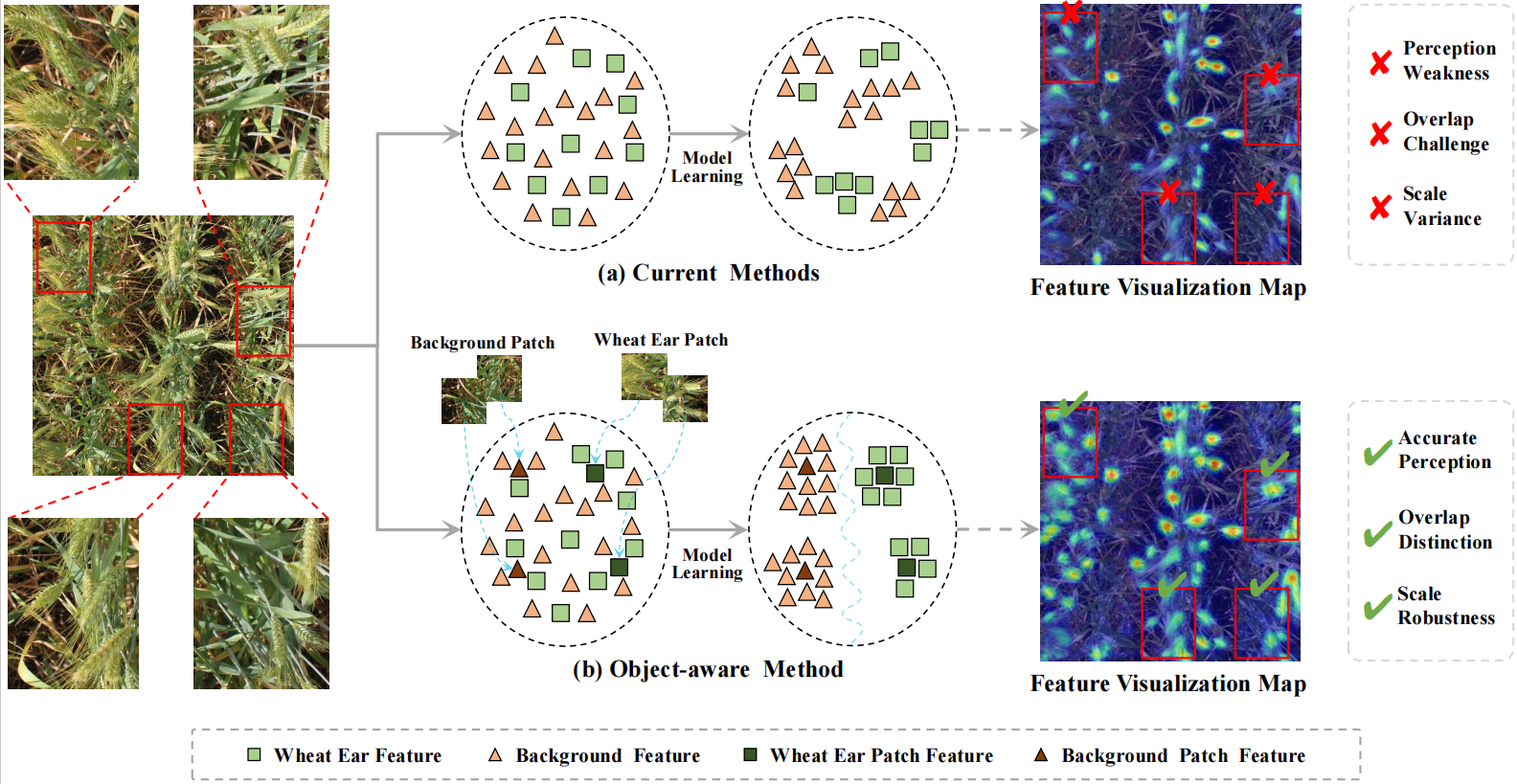
Figure 1: (a) Current methods count wheat ears from the full image but often fail with overlaps and background noise. (b) The object-aware method uses wheat ear and background patches to guide learning, improving accuracy in complex and cluttered scenes.
Application Prospects
Accurate object counting is key for smart farming, helping with crop monitoring, yield prediction, and management. WheatGOAT uses object-aware vision to count wheat ears from images automatically, reducing manual work and improving tasks like early problem detection and precise farming. It can also adapt to other crops and supports measuring traits for breeding, making it a useful tool for modern agriculture.
Research Team
SAMLab